

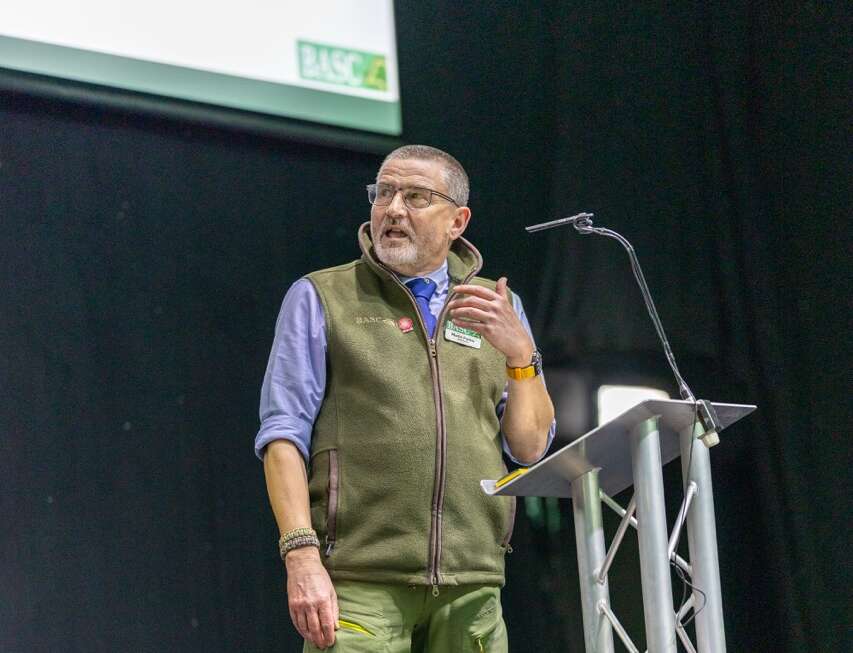
Martin Parker, head of firearms at BASC, opened his presentation at the recent National Gamekeepers’ Organisation conference with a familiar admission, he is still resorting to Freedom of Information requests to gather data on staffing and costs. That alone speaks volumes about the state of firearms licensing in England and Wales.
Parker, who has compiled two major reports on licensing performance (in 2022 and 2025), warned that a system built on public safety is now being undermined by severe inconsistencies between forces, extreme delays, and unclear decision-making. Yet the picture is not all bleak: there are signs of progress and pockets of good practice that could point to a better future if the right structures are adopted.
Parker began by highlighting the continued strength of public safety within the current licensing system, a point often lost amid high-profile tragedies. The average number of homicides involving legally held firearms remains between 3.8 and 4.2 per year, across a firearms-holding population in excess of half a million. “These are tiny numbers,” he said. “Public safety, in terms of preventing criminal misuse, is being well served, and has been for decades.”
That position is reinforced by suicide data. Statistically, given the UK’s male suicide rate, between 60 and 70 certificate holders may take their own lives each year – a tragic figure, but one that has no evidence of being disproportionately high within the shooting population. “The only people who can actually commit suicide, as a general rule of thumb, with a firearm, are people who have a firearm or shotgun certificate. Often licensing departments come in for a lot of criticism if there is a suicide using a firearm, but I think that is unjustified. And in terms of public safety, there is nothing to suggest there is an increased level of suicides within the shooting community.”
Those facts matter, because they counter claims that licensing must become more restrictive on safety grounds. But Parker’s argument is not that the system is safe enough. Rather, it’s that its current failings lie not in risk management or decision-making, but in inconsistency, delays and resource allocation – issues that ultimately undermine public trust.
His findings revealed striking variation in the cost of processing a certificate between different forces. “Imagine pulling onto a petrol forecourt and seeing fuel priced at £3 a litre,” he said. “That level of variation would rightly cause outrage.” The same principle, he argued, applies to licensing.
Costs were just the start. Parker found significant inconsistency in how guidance was interpreted, how conditions were imposed and how revocations were managed. He went as far as to describe some conditions on certificates as “a real bugbear,” listing examples where wording was so contradictory that even senior licensing managers were unsure how to interpret them. “Most of the time, the only condition you really need is: ‘The firearms and ammunition on this certificate are used for any lawful purpose’.”
The most serious concerns relate to turnaround times. Parker highlighted forces where renewals take more than a year and one case where a grant application had been outstanding for four years. “That is totally unacceptable,” he said. “The impact on the gun trade is massive. We’ve lost around 200 RFDs in the past two quarters. We cannot say none of that is related.”
One of the most revealing findings from his 2025 report was the lack of correlation between resources and performance. “Some of the best-performing forces are among the most expensive. Others, also performing well, are among the cheapest.” In other words, money alone cannot solve the problems of inconsistency and inefficiency.
His conclusion? In its current form, firearms licensing in England and Wales remains safe, but structurally flawed. It is, Parker said, “a postcode lottery,” and no amount of local improvement can fix a fundamentally fragmented system.
His recommendations were bold. First, the introduction of a national licensing model similar to Scotland’s, which moved from eight regional forces to a single licensing unit under Police Scotland. That transition led to improved consistency and performance, while still allowing local involvement in decision-making. Second, stronger regulation of licensing standards, enforced, rather than advised, with external oversight capable of mandating changes rather than recommending them.
He also proposed removing chief constable autonomy over firearms licensing, making it a national responsibility. “There is no justification for maintaining autonomy on such a technical and highly regulated issue,” he said. He pointed to the DVLA and passport office as examples of national systems that are simpler, faster and more consistent.
With the Home Office poised to consult on Section 1 and 2 convergence, a move that risks further pressure on already stretched licensing departments, Parker’s message comes at an important moment. The foundations of public safety remain intact, but the structure around them is beginning to fail.
For gun trade professionals, the message is clear: keep pushing for fairness, consistency and reform, and don’t assume the current system can withstand much more strain. Reform is not just desirable, Parker concluded, it is now unavoidable.

